Why There’s No Such Thing as Christian Grimdark

First, a special thanks to Josh Castleman for pointing me to the interview with Steven Erikson I’ll be thinking through in this post. Before you click on that link, know there’s some colorful language sprinkled throughout. Just so you know…

So in the linked interview, Steven Erikson, author of The Malazan Book of the Fallen and other novels, defines the current trend in fantasy literature which many have called Grimdark. Erikson’s take on Grimdark differs from many others in that he doesn’t focus on the “grittiness” of the stories or the often rampant violence they contain. No. Erikson looks deeper, saying: “As a writer I can’t help but look at another author’s work of fiction from a perspective of what, how and why. What is being said, how is it being said, and finally, why is it being said.”

It’s the why that stands out to me and to Erikson, and it is the why that answers the question in this post’s title. So why is Grimdark gritty, visceral, and hopeless? Because it’s taking its cues from the ethosphere–Erikson’s term for the ethos of the culture surrounding you–of both authors and readers, and sadly enough that ethosphere is a Nihilistic one. Many experience this world as a hopeless one, devoid of compassion, justice, mercy, and love where there is no chance for redemption or reconciliation. In short, they recognize that this world is broken, but they don’t see any hope for its healing.

And that is why there cannot be, by definition, Christian Grimdark. If we write from within, and we leave something of our souls on the page when we do, as Christians we cannot leave our stories as hopeless ones because we do not believe that is the way this world will end. If we are, as Erikson says, “driving towards authenticity” our stories must contain something of that hope we carry. That’s not to say that every story must end hopefully, or with all the pieces put back together, but there must be room for it. We must as readers be able to see how redemption is possible, even if it’s only hinted at beyond the story’s end. Because this world is broken and many days and weeks end in the darkness and brokenness of despair, but that’s not where the story ends. This world will be redeemed and made whole once more.

So go ahead and tell the dark and gritty story you have to tell, let it pour out into the secondary world you’ve invented, but if you want to be authentic in your writing, make sure there’s room in all the grit for faith, hope, and love–in short, for redemption. Because that is the foundational reality the primary world is built upon.

The 12th Annual German Tolkien Society Seminar

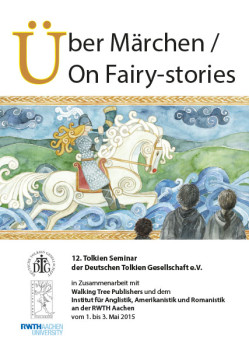
Tolkien-Seminar-2015-249x350From May 1st through 3rd I had the wonderful opportunity to attend the 12th Annual German Tolkien Society (DTG) Seminar held this year in Aachen. I had high hopes for the conference since the focus was on Tolkien’s seminal work, On Fairy Stories. The conference did not disappoint.

The first day featured lectures exclusively in English (which was good for me since my German skills allow me to understand maybe one out of every hundred words), though the presenters were German, Swiss, Irish, and American. Gerard Hynes of Trinity College Dublin delivered the highlight lecture of the day for me on “Theorists of Sub-Creation before Tolkien’s ‘On Fairy Stories'”. He emphasized the uniqueness of Tolkien’s presentation while discussing historical ideas that didn’t necessarily contribute to Tolkien’s thoughts or form a narrative tradition for him to work from, but still created a milieu that made his theory possible. Loved it!

Day two was a real standout though. I slid in a bit late to Marguerite Mouton’s lecture just in time to be blown away by a text I hadn’t really paid much attention to before: Tolkien’s little book The Smith of Wooton Major and the included essay by Tolkien on Faerie. Add that one to my list of books to buy. Anca Muntean added more books to my to-read list and gave me lots to think about. But as good as those lectures were, the highlight of the day was meeting Fr. Guglielmo Spirito (Fr. William), Franciscan friar and Tolkien expert. We were chatting before Anca’s lecture and when he found out what I’m working on at Durham he said, “I’d like to read that,” and gave me his card. Recognizing his name from the literature review I conducted last Fall, I decided to hang out with him as much as he would allow, which was, graciously enough, quite a bit.

2015-05-02 10.40.40           2015-05-02 15.49.55

After a delightful lunch with many of the presenters and a grand tour of the Aachen Dom, Thomas Fornet-Ponse left me in the dust with his discussion of Utopias vs. Heterotopias as possible ways of understanding Faerie. I understood some of it, but a lot of it was just over my head. But Claudio Testi brought things back down to a level I could understand with his discussion of Tolkien’s use of Thomistic analogy. He also confirmed something I had been wondering for a few months: Tolkien was familiar with the works of French philosopher Jacques Maritain. Good to know!

And finally, day three was a delight. Fr. William kicked us off with a brilliant (and totally applicable lecture) “Children are meant to grow up, and not to become Peter Pan” in which he stressed that Fairy Stories should return us to the Primary World, but further they should lead us to live changed lives when we get back. Absolutely! Fr. William’s discussion of what it means to live a changed life was right on point for the work I’m undertaking. Next, Lukasz Neubauer discussed Tolkien’s Christianization of the Old Germanic literary trope of the beasts of battle through the utterly awesome and eucatastrophic eagles. Absolutely fascinating! And the brilliant Thomas Honegger ended things with a look at Tolkien’s Sellic Spell and Beowulf.

I thoroughly enjoyed my time at the conference and hope that this is not the last of the DTG seminars I have the opportunity to attend!

All I’ll say about this year’s Hugo nominations

There’s a great big tide of Internet hullaballoo over this year’s Hugo Award finalists. If you neither know what the Hugos are nor have any idea what I’m talking about, you can probably just skip this entry.

Anyway, lots of people are suggesting how to vote and giving good reasons for those opinions, others are encouraging their readers to vote their conscience (which is a remarkably practical suggestion). I will only weigh in on this by referring to my reviews of the pieces the Puppies pushed through onto last year’s ballot:

The Exchange Officers

Opera Vita Aeterna

Let me offer one simple suggestion: maybe their stories haven’t won, not because of some conspiracy within the Sci-Fi/Fantasy community, but because they’re not good enough to win. Just throwing that out there.

Two Feet Apart

This is the first short story I had published. It appeared on the Residential Aliens website (now taken down it appears) in April 2010. It was an exciting thing, having someone pay me for my writing, even if it was only a small amount.

Stephen’s eyes opened and his brow furrowed, puzzled. Something was different, but what? He looked around him, and his room looked the same; all his furniture was in the right spot, the central air conditioning and filtering unit was whirring away contentedly, and . . . he could hear the central air being pumped into his room. He had never heard that sound before. It had forced air into his room for the past twenty years and yet this day marked the first time he had ever heard it. Odd that something so simple can stand out all of a sudden, he thought as he got off the couch and headed into the kitchen for a snack.

As he stood in the five-by-five cubicle, his shoulders began to shake, gently at first, but with increasing force, until a loud laugh burst from his diaphragm. As if I could even get any food without my DLS operating, he thought happily. His chuckles continuing, he put on his jacket and stepped outside into the hallway of his high-rise apartment complex and headed for the elevator. The two-hundred some odd stories between him and the ground would take only a minute to pass, so Stephen didn’t have much time to focus on the polychromatic digital display as the numbers swept past like the flow of traffic on the multi-tiered freeway outside his apartment. But Stephen did notice, once again, for the first time. It’s amazing, he thought. Has this always been here or was it just recently added? If it’s always been here, I would have noticed it before now. It must be new.

The elevator touched down on the ground floor and Stephen strode out to the front doors and into the street. The air was clean and the sun was bright, but it was always like that. Wasn’t it? A steady flow of cars and pedestrians swept past him. As Stephen watched, he noticed each pedestrian walked about two feet behind the person in front of him. Hundreds of people passed by and each person was spaced evenly—two feet apart. The cars too, though they moved so fast it was hard to tell exactly, were spaced evenly it seemed—two feet apart. And strangely, with all the traffic, both human and machine, there was hardly any sound on the street.

How odd, Stephen thought, as he merged into the pedestrian traffic headed downtown, toward the DLS office. Stephen walked along with the crowd, looking around as he went. Splotches of green burst into sight as he rounded the corner—trees. Had he ever noticed those trees before? Stephen stopped and as he did, the traffic behind him did also. A ripple of confusion passed through the crowd milling in consternation behind him. A line began to form as confused citizens focused their eyes on this unprecedented roadblock. The man behind Stephen even began to sweat in perplexity. At first, Stephen didn’t notice the disturbance his momentary pause had caused; he was too enraptured by the soft speckling of bleach-white blossoms on a background of verdant green leaves. Nature was something he was used to seeing through his DLS, but not through his eyes. It existed in some far off place, but not in his own city.

Gradually another new feeling swept over him, and he was aware, for the first time in his recollection, of the people surrounding him. He felt their confusion and the press of bodies stacking up behind him. He glanced back at the sweating man, who grimaced as though physically pained by the interruption of his normal routine, flashed a small, apologetic smile to the obviously uncomfortable man and danced his way through the evenly spaced two-foot gaps to a spot clear of traffic. The pedestrian traffic immediately picked up in his absence, and no one spared him another glance.

How did I fail to notice these colors? Stephen wondered. They were so vibrant, so bold, they really were impossible to miss. And with the blue sky spread out behind them, peeking mischievously between the branches, he could almost have believed they wanted to be noticed. Almost. The tree may have been beautiful and that thought may have been interesting, but he had no time for either. Neither did he have the patience to ponder either in more depth than he already had. Perhaps these trees are new too, he thought, smiling, and jumped back into the flow of traffic.

But Stephen quickly grew bored with the two foot buffer zone between every person and began to vary his pace; walking first faster than normal, whizzing past people on his right and left as though he were one of those race cars the DLS was always showing, then walking so slowly that traffic once again began to pile up behind him, and the sudden focus of the people around him became a palpable thing. In truth, he found it all rather amusing. Imagine that people could get so flustered by something so simple.

In all, Stephen enjoyed his four-block walk, enjoyed it more than he could remember enjoying anything. There were so many things he noticed for the first time that he began to lose track. He heard birds serenading an unlistening and uncaring populace; he saw butterflies flitting and fluttering across the street, thinking butterfly thoughts and dreaming butterfly dreams; he felt the sun gently caressing his neck and shoulders with its tender warmth; he saw occasional clouds drifting past on errands of their own; he watched a trail of ants bustle across the sidewalk, each walking at its own pace in zigs and zags with no regard for space between them, carrying little scraps of food for their larvae; he even saw a stray dog sitting miserably in the shade of a building, all its hopes of an affectionate pat on the head extinguished by long months of being overlooked—or more accurately, by long months without even being noticed. The dog saw Stephen watching him and began to slowly wag her tail starting with the faintest flicks of the tip, and proceeding to full tail wags when she saw Stephen smile.

Stephen looked up from his new friend and saw the building he sought just a few yards ahead, “Direct Linkage Services” etched in the marble façade. He smiled once more at the dog, waved to her, and walked into the foyer. I’ll go back and scratch her ears on my way out. The dog watched him go and its tail slowly wound to a halt.

After a few minutes of searching he found an open repair station. As soon as he stepped into the small, metal-framed structure a handsome but unremarkable face appeared on the screen in front of him.

“Welcome citizen,” the face smiled inhospitably. “Please stand still while I verify your identity and check your account status.”

Two small pods dropped from the ceiling. One hovered in front of his face, scanning the iris of each eye, while the other zipped from his fingertips to the top of his head, where it removed a short brown hair. He nearly reached out to grab his hair back from the machine—he didn’t exactly have a lot of brown hair left to spare. The conquering army of age was advancing across his scalp, leaving outposts of gray sentinels guarding against any revolution by the browns attempting to reclaim lost ground. As each pod finished its duty, oblivious to his consternation, it disappeared into the hole it came from just moments before.

“I apologize for the delay citizen,” the face sympathized unfeelingly, “it will take a few minutes to process your information. I appreciate your patience.”

Stephen stood quietly looking around at the empty metal walls and soon became bored. There was really very little to see inside the machine, and the smiling face had disappeared—apparently to analyze his information personally. I can’t remember ever being this bored, he thought as he fidgeted with the buttons of his shirt. It seemed that days passed, perhaps even years, before the face returned, still smiling.

“Stephen Redman, it is my pleasure to service you. I am creating a new Direct Linkage System, which we will insert to replace your faulty one. It will be just one moment.” And with that, the smiling face disappeared again.

The years turned to decades as Stephen waited, still fidgeting with his buttons. Stephen’s right hand reached up to touch his hair as he idly wondered if more gray hairs had sprung up to replace the brown while he waited. His thoughts drifted back to the day when the DLS went on the market. He had been first in line, camped out the night before. “After all,” he had said, “what’s not to like about it?” Earbuds, screens, monitors, keyboards, touchpads, phones–all were things of the past. Wires had been done away with years before, but this . . . this was the future! Direct connections, always active and available. It was all of his communication and entertainment needs bundled into a product he didn’t even need to carry. It was a beautiful thing. But I’ve seen beautiful things today too, haven’t I? More beautiful than this, I’d wager, and actually seen them too, not just in my mind, but with my eyes.  The hatch opened and the pods came out again, thrusting Stephen’s thoughts back into the moment, the all-important now.

The pods descended slowly from the ceiling to hover, one at each temple, two feet apart. They circled his head, slowly at first, but with steadily increasing velocity. A field of electricity formed around the rim of the pods’ orbit, crackling and sparking. With a soft pop, the electric current around him dissipated and the pods ascended back into the ceiling.

The smiling face returned. “Your new DLS has been implanted. It will be activated in three-two-one-”SNAP!

Life returned to Stephen then and there. A steady stream of images and information filled his mind, connecting him directly with every other human on the planet, revealing events from around the globe. Messages from his friends had stockpiled during the hours his DLS had been down, asking if he was dead, or incapacitated in some way.

The doors opened and Stephen walked out, his eyes flitting unseeing past the shy flicks and wags of a dog’s tail, so consumed was he in watching in his mind the image of some foolish man with hair more gray than brown standing by a white-blossomed tree, holding up the flow of traffic. Strange person, Stephen thought as he stepped out into the sunlight, slipping without a thought into the traffic flowing past, everyone walking two feet apart.

A Bruised Reed He Will Not Break

I see him descending the mountain with a crowd. Does he know I’m here, on the edges and removed? Outside. Always outside. Does he have words for one such as me or are his words for them alone? I must know, for only he can help.

“Unclean!” I shout. “Unclean!”

With the babble of voices surrounding him, no one hears. I cry louder.

“Unclean! Unclean!”

Those closest to me hear my words and scatter. Those beside them turn and see me: torn clothes, hair uncovered, hands covering my mouth while I shout. They understand even if they can’t hear. A path opens.

Not like the parting made for princes or priests. No. More like the Sea’s parting—violent and eager to return to its resting place.

But the Teacher stands silently, eyes fixed on me. I can’t hold back. I run to the man and fall at his feet. I dare not touch those sacred feet or even brush his sandals. Words bubble within me, but for a time I can say nothing, just kneel with my forehead in the dust at his feet.

The crowd grows impatient, its unease palpable, so at last I speak.

“If you’re willing, you can make me well.”

It’s all I can think to say. I look at my scabbed hands and flaky skin. My body breaking into pieces, the stuff that binds it dissolving before my eyes. It is too much to ask, even of him. This is my lot, my fate, the will of Him who made me. I’m prepared for a rebuke, but it doesn’t come.

Instead, a hand settles on my shoulder. I gasp.

“I am willing,” he says.

There is no flash of light, no thunderclap. But skin that was dead is now alive. My hands stretch out—whole and unmarred—to cradle those blessed feet. His hand rests on my shoulder still, holding me together as I weep in the dust and dirt.

I’ve been healed.

I am whole.

I belong.

Lux et Love Aeterna

O Lux Aeterna, Uncreated Bright,

kindle our hearts with flame unperishing

that we might shine, refractions of your light

aglow in your eternal cherishing.


May our love, as yours, be bright with splendor:

a beacon of hope, a torch in darkness,

that all may find your embrace so tender,

so welcoming, so kind, so free in us.


May our love lead home the lost and broken,

that seen and known their freedom they may find,

that they might hear afresh your love spoken,

that your love and light might unblind the blind.


Grace, let us be for them a lantern, a

window to your heart: Amor Aeterna.

Nailed it!

So last week I briefly shared one of the things Peter Jackson got wrong, and to be fair it’s not as big an issue for me as his treatment of Faramir was in The Lord of the Rings trilogy, but that’s another issue. So what did Jackson get right in the third Hobbit film? What had me watching in wrapt attention yelling “Yes! Yes!” in my head so loudly that I didn’t even pay attention to the subtitles on the bottom of the screen?

Galadriel. Jackson portrayed her perfectly. But the small detail that have me raving was what Galadriel held in her hand as she called forth their true enemy, forcing him to reveal himself. You see, Galadriel is something special among the elves of Middle Earth. She is the last elf remaining in Middle Earth of those who saw the light of the trees in Valinor. She has actually seen the closest thing Ea (the world) had ever held to the uncreated light of Iluvatar. She saw that light and yet chose to leave it and return to Middle Earth. She abandoned the purest light the world could offer in exchange for the twilight. But yet, she bore it with her. She carried some of that light within her and this made her truly a force to be reckoned with.

But with that said, she was not of Sauron’s order. He, like Gandalf (Mithrandir), was one of the Maiar–a lesser order of angelic being–and she is a child of Iluvatar–bound to the world He created. But in her hand she carries a vial of water from her pool and this water contains the reflection of Earendil’s star–the last of the Silmarils created in ages long past by Feanor to preserve the light of the trees of Valinor. It is this light that forces Sauron and his wraiths to reveal themselves, because in Tolkien’s mythology the light has tremendous significance. This is why the elves (and later Frodo and Sam) cry out “Elbereth! Gilthoniel!” in times of greatest darkness. Elbereth and Gilthoniel are elvish names for one of the Valar (the greater order of angelic beings), Varda, who is most closely associated with the uncreated light of Iluvatar. They are, in essence, calling out “Light! Light!” in the darkness and watching the darkness flee. Brilliant stuff!

The simple fact that Jackson placed that vial in her hand for that crucial scene, speaks volumes about his familiarity with Tolkien’s mythology, which begs the question why he was so willing to play fast and loose with other pieces of Tolkien’s epic? Only Jackson can answer that, but for this little piece that Jackson totally nailed, I salute him!

For a fascinating read on the role of light in Tolkien’s mythology, see the amazing book Splintered Light, by Verlyn Flieger.

Just One of the Things Peter Jackson Got Wrong

Let me just first say that I love me some Tolkien movies. My first reaction on hearing Peter Jackson was turning The Hobbit into three movies was disappointment, but that lasted only until I realised it meant I would have more movies to watch and (hopefully) enjoy. And I did enjoy them, but not as a presentation of Tolkien’s books–rather as an adaptation of them. Because, let’s be honest, there’s a lot in those movies that was never Tolkien’s intention, and most of it could be cut without any real harm to the plot. Take the whole love triangle bit. That simply does not fit in Tolkien’s mythology, at least not as I understand it.

If you read The Silmarillion, which I think you should most certainly do, you will quickly see that there is a fundamental difference between elves and men (and even orcs) on one side, and dwarves on the other. Elves and men were created by the sole working of Iluvatar (God) whereas the rest of creation was propounded by Iluvatar as a musical theme to be sung by the valar (angels) and through their singing to bring into being the idea of Ea (the world). Iluvatar is the only one who can actually make the world exist, but the valar participate in that making as sub-creators. Orcs are the result of Melkor, or Morgoth’s, twisting of some of the first elves in the darkness of his stronghold. So even though they are bent and evil, they are still made by Iluvatar himself. Dwarves, on the other hand, are more like the world in how they were made. Aule, the master-craftsman of the valar, wanted to make creatures as Iluvatar had, not to dominate them, but to image his creator through the use of his gifts, and so he made the dwarves. But just as the world as sung by the valar had no life in it (it lacked the Flame Imperishable), so too did the dwarves. It was only after Aule explained himself and his motivations to Iluvatar that Iluvatar consented to breathe into them the Flame, and that only after the elves had awoken in Middle Earth as the firstborn children Iluvatar intended them to be.

So, that’s really just a long-winded way of saying that in my understanding though friendship, fellowship, and camaraderie between elves and dwarves is both possible and encouraged, a romantic relationship is most definitely not. The whole love triangle is given a great deal of screen time, when it probably wouldn’t even have been feasible in Tolkien’s conception of his world.

But really this post is just a necessary prelude to next week’s post about one thing Peter Jackson got right (and I mean he got it really right). So stay tuned!

How to Read a Book (or The Power of Great Art)

I have long enjoyed literature, though that wasn’t always the case. In 6th or 7th grade I first discovered fantasy literature and that is where the love began. That love has gone through many phases and stages, growing and maturing along the way, but because of it I am always looking out for those who can sympathise, those who can truly understand what happens in me when I read good stories, and can defend those of us who feel their stories deeply. C.S. Lewis was one such sympathiser and his beautiful reflections on the subject are, perhaps, nowhere more clearly stated than in his Experiment in Criticism. Leave it to an apologist to offer such a compelling defense.

The first reading of some literary work is often, to the literary, an experience so momentous that only experiences of love, religion, or bereavement can furnish a standard of comparison. Their whole consciousness is changed.

Perhaps his claims feel far-fetched, but I can attest to them. Stories matter. They make a difference and they call us to respond and interact in much the same way that prayer does–all good art does this. When we sit down to pray, we do not sit down to do something we sit down to meet someone and wait for Him to do something to us. Lewis says this is what good Art invites us to:

We sit down before the picture in order to have something done to us, not that we may do things with it. The first demand any work of art makes upon us is surrender. Look. Listen. Receive. Get yourself out of the way.

In prayer too, the first demand is surrender. In prayer we admit that there is One who is greater than we, and it is to Him that we turn, whether in praise or petition, in joy or lament. We present ourselves and then we look, listen, and attend to Him that we might receive whatever He may choose to give. So too the books we read, the symphonies we hear, the paintings we admire all invite us to receive. And those that are worth surrendering to, worth opening our hearts to receive, will change us. Mort Lauridsen’s Lux Aeterna, Tolkien’s The Lord of the Rings, the poetry of Gerard Manley Hopkins, and Caravaggio’s “Conversion of St. Paul”, all take me beyond myself. They have all done something in my soul and made a lasting change. They have added to my life.

There is a kind of encounter involved with all good art that is similar to the encounter of contemplative prayer. In both, we attend to the other, whether Divine or invented, and are lifted above ourselves while yet remaining ourselves–perhaps even becoming more ourselves. Our eyes are opened, our senses enlivened. We feel awake at last and alive.

In reading great literature I become a thousand men and yet remain myself. Here, as in worship, in love, in moral action, and in knowing, I transcend myself; and am never more myself than when I do.

Welcome!

Hello everyone. If you’ve followed me over from my previous blog, it’s nice to see you again. If you’re new, it’s nice to meet you.

This blog will be a place to write about things that interest me. As a current PhD candidate, you can be certain I’ll be writing about Lewis, Tolkien, theology, and spiritual formation. As a poet and story-teller you will surely find poetry, short stories, imaginative prayer, and maybe sections of longer works in progress. As an avid reader you’ll also find book reviews and recommendations. And who knows what else will turn up here–after all, the world is rich and full of wonder.